
Crystals and African Spirituality: The Sacred Relationship Between Stones, Nature and the Spirit World
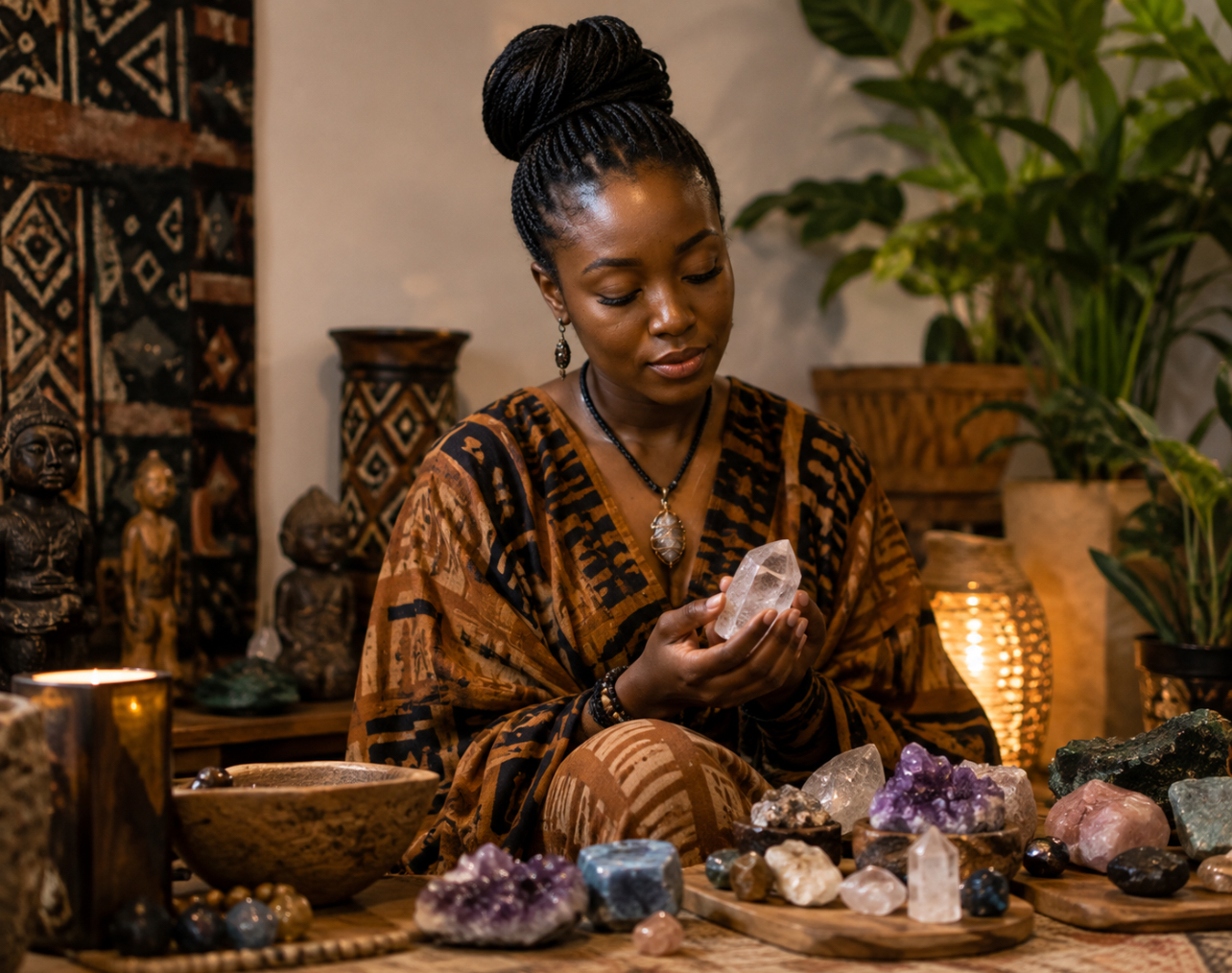
Crystals and African Spirituality: Understanding the Sacred Relationship Between Stones, Nature and Spirit
Long before crystals became popular on social media, in wellness spaces and modern metaphysical shops, African spiritual traditions already recognised something important:
Nature matters.
Land matters.
Water matters.
Trees matter.
Animals matter.
Plants matter.
Minerals, objects and sacred materials can also matter.
Across African societies, the physical and spiritual worlds have often been understood as deeply interconnected rather than completely separate. Contemporary scholarship on Africana religions similarly describes material and immaterial realities as intertwined, with spiritual meaning embedded within everyday life.
This makes the modern interest in crystals and African spirituality particularly fascinating.
But it also requires nuance.
It is tempting to make a sweeping statement such as:
“Crystals have always been central to African spirituality.”
That would be too simplistic. Africa is not one spiritual tradition.
Nigeria alone contains numerous peoples, languages, cosmologies and religious systems, including Yoruba, Igbo, Hausa, Edo, Ibibio, Efik, Urhobo, Itsekiri, Ijaw and many others.
And traditional African spirituality did not necessarily use the modern category of “crystal healing” that is familiar today.
Instead, different cultures developed their own relationships with sacred objects, stones, metals, beads, plants, rivers, trees, earth, ancestors, deities and ritual materials.
Understanding that distinction is essential.
So, when we talk about crystals and African spirituality, we’re really exploring a larger question:
How have African spiritual traditions understood the relationship between the natural world, material objects and the sacred and how does that compare with today’s crystal practices?
Across Africa, spirituality has never been confined to a building, a book, or a particular day of worship.
For many indigenous African traditions, the sacred is woven into the natural world.
The earth, rivers, mountains, trees, animals, celestial bodies, ancestors and physical objects can all participate in a larger spiritual reality. Matter and spirit are not necessarily understood as completely separate realms. In many African religious traditions, the visible world and invisible world exist in relationship with one another.
This is where the modern conversation around crystals and African spirituality becomes especially interesting.
Today, crystals such as amethyst, clear quartz, rose quartz, citrine, black tourmaline and labradorite are widely used for meditation, intention-setting, spiritual reflection and energy work. But it is important not to assume that contemporary crystal practices are identical to traditional African religions.
Instead, there is a deeper point of connection:
Africa has a long history of assigning cultural, spiritual and symbolic meaning to natural materials.
From sacred stones and earth materials to beads, coral, shells, metals and ritual objects, physical materials have historically been incorporated into systems of identity, authority, ritual and spirituality.
Understanding this history allows us to approach crystals with greater cultural awareness not by claiming that every modern crystal practice is “ancient African,” but by recognising that the African spiritual worldview has long made room for meaningful relationships between humans, nature and the unseen.
What Is African Spirituality?
The phrase African spirituality describes a vast range of indigenous spiritual traditions originating across the African continent.
There is no single African religion.
Yorùbá Ìṣẹ̀ṣe, Igbo Ọdịnala/Odinani, Akan traditions, Vodun traditions, Dinka spirituality, Maasai traditions, Kongo spiritual systems and numerous other indigenous traditions have their own cosmologies, sacred beings, rituals, symbols and philosophies.
Even within one ethnic group, spiritual practices can differ between communities.
This distinction matters when discussing crystals.
It would be inaccurate to say that “Africans have always used crystals for healing” as though the entire continent followed one crystal-based spiritual system.
A more historically responsible statement is that many African traditions have recognized spiritual significance in particular natural materials and objects.
For example, archaeological and cultural research demonstrates the importance of beads, including glass and stone beads, throughout Nigerian history. At Ile-Ife and Bida, bead-making and glass-working were connected with religious practices, while research on Yoruba material culture shows that beads could carry meanings relating to wealth, authority, identity and spirituality. That broader relationship between material, meaning and spirit is an important part of the conversation around crystals today.
Did Ancient Africans Use Crystals?
Yes, African societies have a long history of using minerals, gemstones, beads, metals and other natural materials in adornment, ritual, symbolism and sacred contexts.
But this does not mean that every crystal currently sold in metaphysical shops had a traditional African spiritual meaning.
That’s an important distinction.
Archaeological evidence from Igbo-Ukwu in southeastern Nigeria, for example, includes elaborate copper-alloy objects, pendants, anklets, wristlets and tens of thousands of glass and carnelian beads associated with an extraordinarily sophisticated material culture.
The significance of these objects cannot simply be translated into today’s language of “crystal healing.”
They belonged to particular social, artistic, ceremonial and historical contexts.
Likewise, African spiritual systems have often assigned sacred significance to particular natural materials without treating all minerals as interchangeable spiritual tools.
So rather than asking:
“Which crystals did Africans use for manifestation?”
a better historical question is:
“How did particular African cultures understand sacred materials, stones, minerals and objects?”
That question opens a much richer conversation.
African Spirituality Is Not One Spiritual System
Before exploring crystals, we need to establish something fundamental.
There is no single thing called African spirituality.
There are African spiritual traditions.
Plural.
Yoruba spirituality is not the same as Igbo spirituality.
Igbo cosmology is not the same as Akan cosmology.
Edo traditions are not identical to Yoruba traditions.
And the spiritual systems of ancient Egypt cannot simply be treated as interchangeable with those of contemporary southeastern Nigeria.
Even within one ethnic group, practices can vary between communities, lineages and historical periods.
This is why responsible discussion of African spirituality and crystals should avoid turning diverse traditions into one generalized belief system.
Stones, Beads and the African Spirituality
The history of beads in Africa provides another fascinating connection.
Beads have been used across African societies for adornment, status, trade, ceremony, identity and spirituality.
In Nigeria, archaeological discoveries at sites including Igbo-Ukwu and Ile-Ife demonstrate sophisticated bead cultures and long-distance exchange networks. A 2026 discussion published by The Guardian Nigeria, drawing on museum scholarship, notes the presence of large quantities of glass and carnelian beads at Igbo-Ukwu and highlights the cultural significance of beads in Nigerian history.
Yoruba glass beads, including iyùn and ṣẹ̀gi, have also been studied as objects associated with wealth, social power, divine kingship and ritual authority.
This is significant because it challenges the idea that Africans historically viewed stones and minerals merely as decorative materials.
Materials could communicate:
- identity
- social position
- spiritual affiliation
- wealth
- authority
- protection
- ancestry
- beauty
- religious devotion
- community belonging
In other words, material culture was part of spiritual culture.
Sacred Objects in Igbo Spirituality
Igbo traditions offer another powerful example.
Research on Igbo religious symbolism describes categories of sacred persons, places, things, trees and animals, demonstrating how material objects can participate in a larger ritual and symbolic world.
Igbo material culture contains numerous objects with spiritual, moral and social significance.
Among them are:
• Ofo
• Ikenga
• Nzu
• Oji
• Sacred staffs
• Shrine objects
• Ritual vessels
• Beads and ornaments
• Metal objects
• Carved objects
• Natural materials
Research on Igbo cultural heritage likewise documents objects such as Ikenga and Ofo, as well as natural materials including nzu (white chalk) and omu (tender palm fronds), which carry particular symbolic meanings.
This is important because it demonstrates something often overlooked in conversations about African spirituality:
Spiritual significance does not require an object to be called a crystal.
Nzu: A Powerful Example of Sacred Natural Material
Among the Igbo, nzu, commonly translated as native or white chalk, has important cultural and ritual associations.
It can signify concepts such as:
• Purity
• Peace
• Hospitality
• Sacredness
• Agreement
• Ritual intention
Research on Igbo material culture identifies nzu among revered natural objects and describes its symbolic significance.
This provides an important lesson for anyone researching crystals and Nigerian spirituality.
Rather than searching only for modern crystals such as amethyst or rose quartz, we can broaden the conversation to include the many natural substances that African societies have historically treated as culturally and spiritually meaningful.
The Kola Nut and Sacred Materiality
Another powerful Igbo example is the kola nut, oji.
The kola nut is not a crystal or mineral.
Yet its ritual importance illustrates how ordinary physical matter can become a profound spiritual symbol.
Research published in the Igbo Studies Review describes the kola nut as a sacred symbol connecting the living and ancestral worlds in Igbo tradition.
This is exactly why the phrase “African spirituality is about energy” can be too vague.
Traditional systems are often more specific.
They involve:
• Relationships
• Ancestors
• Deities
• Land
• Moral order
• Ritual
• Community
• Language
• Objects
• Offerings
• Symbolism
• Divination
• Responsibilities
The object is part of a much larger system.
Stones and the Yoruba Spiritual World
Yoruba spirituality provides a particularly rich context for understanding the relationship between nature, material objects and sacred power.
The Yoruba concept of àṣẹ is often translated imperfectly as spiritual authority, power or the capacity for things to bring about effects.
Within Yoruba religious thought, sacred objects and ritual materials can participate in relationships between humans, Òrìṣà, ancestors and the wider spiritual world.
But it is important not to reduce àṣẹ to the modern concept of “crystal energy.”
They are not automatically equivalent concepts.
A modern crystal practitioner might say:
“This crystal has powerful energy.”
A Yoruba practitioner may be operating within a completely different theological and ritual framework involving Òrìṣà, ancestors, ritual authority, offerings, divination and àṣẹ.
The vocabulary may overlap superficially, but the underlying worldview can be very different.
Crystals and the African Understanding of Nature
One of the most beautiful ways to approach crystals within an African spiritual framework is through the relationship between humanity and nature.
Many indigenous African philosophies emphasize interconnectedness.
The natural world isn’t simply a collection of resources existing outside human life. Land, water, plants, animals, ancestors and spiritual forces can participate in a larger cosmological order.
This perspective can be seen clearly in Igbo traditional religion.
Within Igbo cosmology, Ala/Ani, the Earth deity, is deeply connected with morality, fertility and the ordering of communal life. Academic discussions of Igbo traditional religion emphasize the importance of Ala within the spiritual and ethical structure of Igbo society.
This makes the earth itself spiritually significant.
And crystals, of course, are products of the earth.
That doesn’t automatically make every crystal sacred.
But it offers a meaningful philosophical framework for understanding why someone might approach a stone with reverence rather than treating it as nothing more than a decorative object.
The Difference Between Traditional African Spirituality and Modern Crystal Healing
This distinction is essential.
If you search online for African spirituality crystals, you will find many modern practitioners combining African symbolism, ancestral practices, crystals, herbs, meditation, astrology and energy work.
Some of these practices may be personally meaningful.
But they should not automatically be presented as traditional African religion.
Traditional African spiritual systems
Traditional indigenous religions may involve:
- ancestors
- divinities
- community
- sacred landscapes
- ritual specialists
- divination
- offerings
- initiation
- oral traditions
- sacred objects
- moral laws
- ceremonies
- lineage
The specific practices vary enormously between cultures.
Modern crystal spirituality
Modern crystal practice may involve:
- meditation
- intention setting
- energy work
- chakra practices
- manifestation
- crystal grids
- journaling
- spiritual baths
- altar arrangements
- mindfulness
- personal ritual
These practices can exist alongside an individual’s cultural or spiritual identity, but they should not be falsely presented as universal ancient African customs.
This distinction makes the modern practice more respectful, not less spiritual.
Why Are Crystals Popular in Modern African Spirituality?
There are several possible reasons.
1. They Are Visually Powerful
Crystals are naturally beautiful.
Their colours, formations, translucency and patterns make them attractive objects for altars, jewellery and personal spaces.
2. They Create a Physical Anchor for Intention
Holding a physical object can make an abstract intention feel tangible.
For example:
Clarity
Protection
Courage
Self-love
Abundance
Grounding
The crystal becomes a physical reminder.
3. They Connect People With Nature
Modern life can feel increasingly disconnected from the natural world. renewed interest in crystals across Nigeria and the African diaspora reflects a broader return to spiritual self-exploration and indigenous identity.
Crystals are literally geological formations.
Working with them can inspire curiosity about:
• Earth
• Minerals
• Geological time
• Natural formations
• Landscapes
• Ancient environments
4. They Fit Into Personal Ritual
A crystal can easily become part of:
• Meditation
• Journaling
• Prayer
• Intention setting
• Breathwork
• Personal reflection
• Home altars
Again, this doesn’t automatically make the practice traditionally African.
It means the crystal can become meaningful within a person’s contemporary spiritual life.
For some people, crystals are simply beautiful natural objects.
For others, they represent intention, grounding, meditation or personal transformation.
And for others, crystals are part of a larger spiritual practice involving ancestors, nature, prayer, divination or cultural reconnection.
Social media has also contributed to the popularity of crystal spirituality among younger Africans.
Platforms such as Instagram, TikTok and Pinterest have made crystals more visible and accessible, while African creators are increasingly exploring indigenous spirituality, ancestral traditions, herbalism, divination and cultural history.
This has created a fascinating meeting point between modern metaphysical practice and African cultural consciousness.
Crystals and Ancestor Work
The relationship between crystals and ancestral spirituality deserves particular care.
Many African spiritual traditions place significant importance on relationships between the living and ancestors.
But there is no single traditional rule saying:
“Use this crystal to communicate with your ancestors.”
Specific ancestral practices belong to specific cultures and traditions.
If you incorporate crystals into ancestral reflection, it is better to describe the crystal as a personal symbolic tool rather than claiming that a particular stone is universally required for African ancestral communication.
For example, you might place a meaningful stone beside a photograph, journal or family object while reflecting on your lineage.
The meaning comes from your practice.
Crystals and African Ancestral Healing
The phrase “ancestral healing” is increasingly common in modern spiritual communities.
It can refer to many different things, including:
• Reflecting on family history
• Processing inherited patterns
• Honouring ancestors
• Reconnecting with cultural identity
• Learning ancestral traditions
• Healing relationships
• Reclaiming cultural knowledge
Crystals can be used symbolically during such practices.
But they should not be presented as a universal traditional African treatment for ancestral problems.
African traditional healing systems themselves are diverse and include complex bodies of herbal, ritual, divinatory and community knowledge.
African Spirituality and the Idea of Sacred Objects
A useful way to understand crystals is through the broader African concept of spiritually meaningful objects.
A sacred object isn’t necessarily powerful because of its physical appearance alone.
Its meaning may come from:
material + symbolism + relationship + ritual + cultural context.
This is an important distinction.
A stone sitting on a shelf is a stone.
A stone that has been incorporated into a specific religious system, given cultural meaning, associated with a divinity or used within a ritual context may have an entirely different significance.
This is why it is important to learn the tradition behind an object rather than simply assigning a generic “African spiritual meaning” to it.
Crystals Often Associated With African Spiritual Practices Today
While these associations should not be confused with universally traditional African meanings, certain crystals have become popular among contemporary African and African-diasporic spiritual practitioners.
Clear quartz is commonly used in modern metaphysical practices for:
- clarity
- meditation
- intention setting
- spiritual reflection
- amplifying personal intentions
Its transparent appearance also makes it particularly attractive for altar and sacred-space arrangements.
From a contemporary perspective, clear quartz can be used as a symbolic reminder to seek clarity and consciously direct one’s attention.
- Amethyst
Amethyst is one of the most recognisable spiritual crystals.
It is commonly associated with:
- intuition
- meditation
- inner peace
- spiritual reflection
- dream work
For someone exploring ancestral spirituality, amethyst can be incorporated into a quiet meditation space or journal practice.
The important point is that this is a contemporary crystal association, rather than a claim that traditional African religions universally identified amethyst with these qualities.
Black tourmaline is popular in modern spiritual communities for symbolic protection and grounding.
People may keep it:
- near their front door
- beside their bed
- on an altar
- near a workspace
- during meditation
For a modern spiritual practitioner, it can represent boundaries, grounding and the intention to remain energetically centered.
Smoky quartz is often associated with grounding and releasing unwanted emotional weight.
Its earthy appearance makes it particularly appropriate for people who enjoy creating nature-based spiritual spaces.
It can be used during:
- meditation
- journaling
- grounding practices
- intention setting
- reflective rituals
Carnelian has a particularly interesting connection to African material history because carnelian beads were among the beads found at Igbo-Ukwu and other archaeological contexts in Nigeria.
Today, carnelian is commonly associated in crystal spirituality with:
- vitality
- courage
- creativity
- confidence
- motivation
Its contemporary metaphysical meaning and its archaeological history should be kept distinct but together they make carnelian an especially interesting stone for anyone exploring African crystals and cultural heritage.
Rose quartz is commonly associated with:
- love
- compassion
- emotional openness
- self-love
- harmonious relationships
It can be used as a symbolic object during self-reflection or relationship-focused meditation.
Again, this is a modern crystal interpretation rather than a claim about traditional African religious doctrine.
Citrine is frequently associated with:
- abundance
- confidence
- creativity
- prosperity
- personal power
For modern spiritual practitioners, it is often placed in workspaces, businesses or personal altars as a physical reminder of financial and creative intentions.
For Nigerian entrepreneurs interested in combining spirituality with intentional living, citrine can become part of a personal abundance ritual without needing to claim that the ritual itself is an ancient Nigerian tradition.
African Spirituality, Ancestors and Crystals
The subject of ancestors deserves special care.
Many African traditional religions have rich ancestral traditions, but beliefs about ancestors differ considerably between cultures.
In some traditions, ancestors are understood as continuing members of the community who remain connected to the living.
This creates an interesting philosophical relationship with objects.
A crystal doesn’t have to be considered an “ancestor crystal” to serve as a reminder of one’s lineage.
Someone might place a stone beside photographs, family heirlooms, written names or meaningful cultural objects as part of a personal remembrance practice.
The crystal then functions as a symbolic anchor for remembrance and reflection.
That is different from claiming that a particular crystal automatically contains the spirit of an ancestor.
The distinction matters.
Can Crystals Be Used in African Spirituality?
Yes but how they are used depends on the person’s spiritual framework.
Someone practicing a contemporary form of African-inspired spirituality may use crystals for meditation, grounding, intention setting or altar decoration.
Someone following an established indigenous religious tradition may have entirely different practices determined by their lineage, community, divination and spiritual authorities.
There is no single ritual for “African crystals.”
There is no universal African crystal chart.
And there is no one crystal that represents African spirituality as a whole.
Africa is too culturally diverse for that.
Instead, the most meaningful approach is to explore crystals alongside specific cultures, traditions and philosophies.
How to Create an African-Inspired Crystal Altar
If you are interested in combining crystals with African-inspired spirituality, your altar can begin with simplicity and intention.
You don’t need to reproduce another culture’s sacred ritual.
Instead, create a personal space inspired by your relationship with nature, ancestry and spirituality.
- Choose a meaningful location
Select a clean, peaceful area where you can sit quietly.
This might be:
- a bedside table
- a meditation corner
- a shelf
- a dedicated spiritual table
- a garden space
- Choose your crystals intentionally
Rather than choosing stones simply because they are aesthetically beautiful, ask:
What am I currently trying to cultivate?
Clarity?
Grounding?
Courage?
Love?
Creativity?
Protection?
Reflection?
Choose stones whose contemporary symbolism resonates with your intention.
- Include natural African materials
You might incorporate culturally meaningful objects that genuinely belong to your own heritage, such as:
- locally sourced pottery
- traditional textiles
- ethically sourced beads
- wooden objects
- dried botanicals
- shells
- family heirlooms
- artwork
- photographs
Avoid using sacred objects from traditions you don’t understand simply because they look “spiritual.”
- Add written intentions
Write a short statement describing what you are calling into your life.
For example:
I move with clarity, courage and alignment.
Place the note beneath or beside your chosen crystal.
- Spend time with the space
The most important element isn’t how elaborate the altar looks.
It is your relationship with it.
Use the space for quiet reflection, meditation, prayer, journaling or simply reconnecting with yourself.
Crystals, African Identity and Cultural Reconnection
For many people of African descent, spirituality is also connected to questions of identity.
Colonialism, religious conversion, migration and globalization have significantly influenced how African cultures understand and preserve indigenous spiritual traditions.
Today, many Africans and members of the African diaspora are exploring ancestral languages, traditional names, indigenous philosophies, cultural art, traditional foods, herbal knowledge and spiritual heritage.
Crystals can become part of this broader process of reconnection but they should not replace cultural research.
If you’re Nigerian, for example, exploring your heritage may involve learning about your particular ethnic group’s history and worldview rather than simply searching for a generalized list of “African spiritual crystals.”
For an Igbo person, that might mean learning about Ọdịnala/Odinani, ancestral structures, Ala, Chi, Alusi and concepts such as Ofo and Ogu.
For someone exploring Yoruba heritage, it could involve learning about Ìṣẹ̀ṣe, Òrìṣà, Ifá and Yoruba cosmology from appropriate cultural and religious sources.
For someone with Akan heritage, the spiritual framework will be different again.
The deeper you go into the culture, the less generic the spirituality becomes.
African Crystals vs. Crystals From Africa
Another important distinction is the difference between African spirituality crystals and crystals that physically come from Africa.
Africa is extraordinarily rich in mineral resources.
Crystals and minerals sourced from African countries can include varieties of:
- quartz
- amethyst
- tourmaline
- garnet
- fluorite
- aquamarine
- citrine
- jasper
- agate
- labradorite
- sapphire
- emerald
- and many others
But geographical origin does not automatically give a crystal a spiritual meaning.
A crystal mined in Africa is an African-sourced crystal.
A crystal used within a specific African religious practice is a culturally or spiritually significant object.
Those are different things.
At RA TRIBE, this distinction is important because appreciating African mineral wealth can exist alongside appreciating African spiritual heritage without inventing historical claims.
Why African-Sourced Crystals Are Special
There is something inherently beautiful about knowing where a natural stone comes from.
A crystal formed within the earth carries a geological story that may stretch across millions or even billions of years.
African minerals can connect contemporary crystal lovers to the continent’s extraordinary geological diversity.
For a Nigerian crystal collector, choosing African-sourced stones can also be an opportunity to deepen one’s appreciation of the continent’s natural wealth.
But authenticity matters.
When purchasing crystals, ask sellers about:
- country of origin
- mine or region when available
- whether the stone is natural or treated
- whether it is dyed or enhanced
- whether it is synthetic
- ethical sourcing practices
- whether the claimed mineral identification is accurate
A beautiful crystal deserves an honest story.
Are Crystals Part of Igbo Spirituality?
This question requires particular caution.
Igbo spirituality, traditionally known as Ọdịnala/Odinani, is a complex religious and philosophical system rather than a crystal-healing tradition.
Central concepts include Chukwu, Chi, Alusi, ancestors, Ala and moral relationships within the community. Academic scholarship describes Chukwu as the supreme creator and Ala as a particularly important divinity associated with earth, morality and fertility.
Traditional Igbo spiritual practices also involve specific sacred materials and objects.
For example, kola nut, white chalk, Ofo and Ogu, offerings and other ritual materials have particular meanings within Ọdịnala.
Therefore, calling amethyst or rose quartz “Igbo spiritual stones” without historical evidence would be misleading.
A more respectful contemporary practice would be to use crystals as personal spiritual tools while learning about actual Igbo traditions separately.
Are Crystals Part of Yoruba Spirituality?
Yoruba spiritual traditions likewise have their own sophisticated systems of sacred objects and material symbolism.
Stones can have religious significance in particular contexts.
Edun Àrá is associated with Ṣàngó, while Yangí has a specific relationship with Èṣù.
Yoruba bead traditions are also deeply connected with status, power, identity, wealth and religious life. Research into Ile-Ife’s glass-bead tradition demonstrates that these materials were much more than decorative objects.
This makes Yoruba material culture an important area of study for anyone interested in the relationship between stones, beads, objects and spirituality in Africa.
But once again, contemporary crystal healing should not be retroactively presented as ancient Yoruba crystal healing.
The African Spiritual Philosophy Behind Modern Crystal Practice
Perhaps the most meaningful connection isn’t a specific crystal-to-deity correspondence.
It is the worldview that recognizes that the physical world can carry spiritual meaning.
An object can become meaningful through:
- intention
- relationship
- symbolism
- ritual
- memory
- cultural identity
- spiritual practice
That perspective can make contemporary crystal practice feel less like collecting pretty stones and more like consciously engaging with the natural world.
A crystal can become a reminder.
A meditation anchor.
A symbol.
A piece of the earth.
A personal talisman.
A beautiful object that marks an important period of transformation.
Its meaning ultimately comes from the relationship you create with it—and, where a traditional religion is involved, from the tradition itself.
How to Work With Crystals Respectfully
If you want to incorporate crystals into an African-inspired spiritual practice, keep these principles in mind.
Learn before claiming
Research the specific African tradition you’re referencing.
“African spirituality” is not one religion.
Don’t erase existing traditions
Traditional African sacred objects already have their own histories.
Don’t rename them as generic “crystals” simply because they are made from stone or mineral.
Don’t invent ancient history
It is tempting for spiritual marketing to say:
“Ancient Africans used this crystal for abundance.”
Unless there is credible historical or ethnographic evidence, avoid making claims like this.
Authenticity is more powerful than mythology.
Respect sacred objects
Some objects belong within specific religious traditions and shouldn’t be treated as decorative accessories.
Explore your own lineage
If you’re reconnecting with African spirituality, begin with your own cultural heritage where possible.
Learn the language.
Learn the stories.
Learn the cosmology.
Learn the symbolism.
Then decide how contemporary practices such as crystals fit into your personal spiritual life.
Crystals and African Spirituality in Modern Nigeria
Nigeria is particularly interesting in this conversation because the country contains an extraordinary diversity of indigenous cultures and spiritual traditions.
From Yoruba and Igbo traditions to Edo, Efik, Ibibio, Hausa, Nupe, Ijaw and numerous others, Nigeria contains hundreds of cultural histories.
At the same time, Nigerian cities such as Lagos, Abuja and Port Harcourt have thriving contemporary wellness, spiritual and metaphysical communities.
This has created a modern marketplace where people can encounter:
- healing crystals
- incense
- herbs
- spiritual baths
- meditation
- tarot
- sound healing
- aromatherapy
- ancestral practices
- African-inspired spirituality
For Nigerians exploring crystals, the opportunity is not simply to import Western metaphysical ideas.
It is to develop a relationship with crystals that feels intentional, culturally conscious and authentically personal.
Frequently Asked Questions About Crystals and African Spirituality
What is the connection between crystals and African spirituality?
The connection is best understood through Africa’s broader history of assigning cultural and spiritual meaning to natural materials such as stones, beads, coral, shells and metals. However, modern crystal healing should not automatically be described as an ancient African practice.
Did Africans use crystals spiritually?
Various African societies used stones, minerals, beads and other natural materials in religious, cultural and symbolic contexts. Specific practices differed by culture. For example, particular stones hold significance in Yoruba religious contexts, while beads have extensive historical and spiritual importance across parts of Nigeria. (Endangered Material Knowledge Programme)
What crystals are associated with African spirituality?
There is no universally accepted list of “African spirituality crystals.” In contemporary metaphysical practice, people commonly work with stones such as quartz, amethyst, carnelian, black tourmaline, smoky quartz, rose quartz and citrine. Their modern meanings should not be confused with traditional African religious symbolism.
What is the most powerful African crystal?
There is no objectively “most powerful African crystal.” A crystal’s geological origin, mineral properties, cultural significance and personal symbolism are separate considerations.
Are crystals African?
Some crystals are mined in Africa, but crystals themselves are not exclusively African. Africa is one of the world’s major sources of many minerals and gemstones.
What crystals are good for ancestral work?
There is no universal traditional African answer. In contemporary crystal spirituality, people may choose stones such as clear quartz, amethyst, smoky quartz or black tourmaline as symbolic tools for meditation and ancestral reflection.
Can I use crystals on an African spiritual altar?
That depends on the tradition and the purpose of the altar. If you are creating a personal contemporary spiritual space, crystals can be used symbolically. If you are participating in an established indigenous religious tradition, follow the practices and guidance of that tradition rather than improvising sacred rituals.
What is the difference between African spirituality and African-inspired spirituality?
African spirituality generally refers to indigenous spiritual traditions rooted in African cultures, while “African-inspired spirituality” can describe modern practices influenced by African symbolism, philosophy or ancestral traditions.
The distinction is important because modern practices shouldn’t automatically be presented as traditional.
Bringing the Earth Back Into Your Spiritual Practice
Perhaps the greatest lesson crystals can offer is simplicity.
Before they became products in wellness stores, objects on altars or beautiful pieces of jewelry, stones were part of the earth.
They formed slowly.
They weathered landscapes.
They travelled through rivers.
They were shaped by geological forces long before humans gave them names.
Across Africa, humans have also spent thousands of years giving natural materials meaning—wearing beads, working metals, shaping stone, creating sacred objects and incorporating materials from the natural world into systems of culture and spirituality.
That history provides a powerful foundation for approaching crystals today.
Not by pretending that every modern crystal practice is ancient African tradition.
Not by assigning every stone to an African deity.
Not by reducing complex indigenous religions to a list of “African healing crystals.”
But by developing a deeper respect for earth, material, culture, ancestry and intention.
Your crystal can be beautiful.
It can be meaningful.
It can be part of your meditation.
It can remind you of your intentions.
And it can sit within a spiritual practice that honours where you come from while remaining honest about where contemporary crystal traditions come from.
The most powerful spiritual practice is not the one with the most elaborate claims. It is the one rooted in knowledge, intention, respect and connection.
Explore Crystals With RA TRIBE
At RA TRIBE, we believe crystals can be approached as beautiful natural treasures and intentional tools for modern spiritual practice.
Whether you’re beginning your crystal journey, deepening your meditation practice, creating a personal altar or simply looking for beautiful natural stones in Nigeria, choose your crystals with curiosity and intention.
Explore our collection of healing crystals, raw crystals, tumbled stones, crystal jewellery and spiritual tools and discover the stones that resonate with your personal journey.
Final thought
African spirituality does not need to be reinvented to be powerful.
There is already extraordinary depth in African cosmologies, ancestral traditions, philosophies and relationships with the natural world.
Crystals can become part of a modern spiritual journey but the deeper journey is learning to see the earth, culture and ancestry with new eyes.
Your spirituality can be modern without being disconnected from your roots.